
Scenario Narrative
Hotspots for Transformation
In 2050, a mix of conservation agriculture practices, restored ecosystems, and perennial grazing land are strategically placed to maximize environmental benefit.
Scenario Synopsis
In 2050, several land use transitions have unfolded across the Upper Mississippi River Basin, targeted especially on under-producing, marginal agricultural lands.
In priority “areas of concern,” some growers transition from annual crops to perennial grazing systems. Others steward restored ecosystems on former farmland. Other growers place their energies on conservation practice implementation.
These new land uses have supplanted most of the land area used for corn ethanol production in earlier decades, but a handful of growers continue to focus on biofuel production for aviation.
Key Landscape-Related Changes by 2050
- Policies target nutrient runoff hotspots for conversion to conservation agriculture, restored ecosystems, or perennial grazing land.
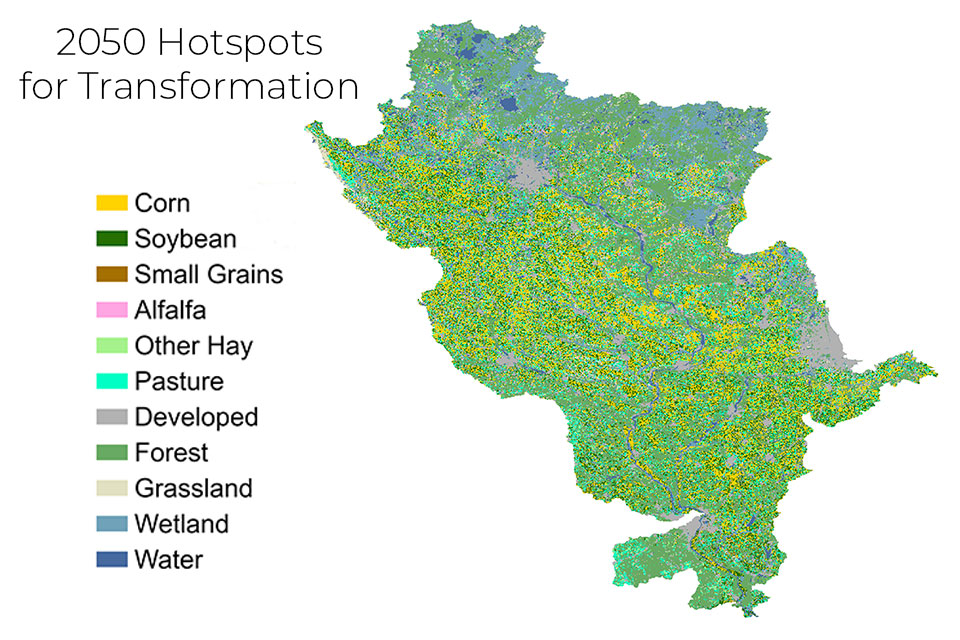
- 15% of total cropland has been converted to a combination of restored ecosystems and perennial agriculture.
- 40% of agricultural lands incorporate cover crops, but the costs of the practice limit wider coverage.
- Corn ethanol production has decreased due to vehicle electrification but still exists to produce jet fuel and other bio-based consumer products.
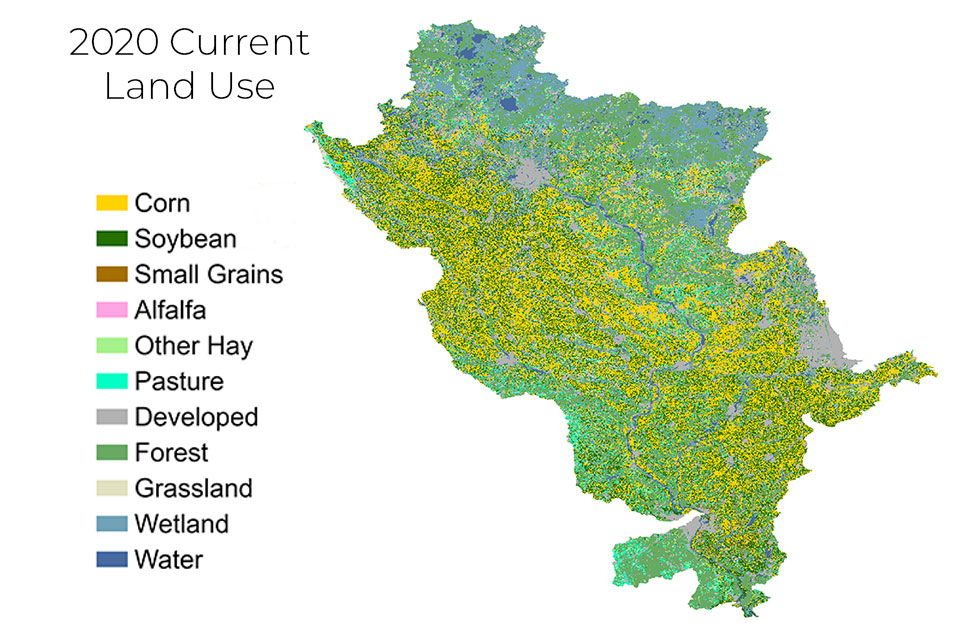
This land-use/land-cover map (left) depicts the Upper Mississippi River Basin in 2050 under the Hotspots for Transformation scenario. Hover over the button above it to compare it with current land use/land cover (as of 2020).
The Full Story
In the 2030s, new resources begin to flow into areas of the Upper Mississippi River Basin that have struggled most with water pollution. New federal, state, and private programs target hotspot water bodies, farm fields, or even subsections of a single field. They offer new resources that allow growers to pivot in a few different ways. Some pivot from row crop production to perennial grazing; others weave restored forests and wetlands into their fields; and others still incorporate conservation practices into their operations.[1↓]
The changes are hard-won, growing out of acute water quality challenges in prior decades.
Stronger storms cause water quality setbacks
Heavy rains become more common over the course of the 2020s due to the changing climate. Alternating drought and storms lead to increased nutrient runoff from farmland, and some producers increase fertilizer applications to keep up with the losses.[2↓]
Carried by runoff from farms and cities, nutrient pollution increases in rivers and lakes, reversing some of the water quality gains of prior years. Cities sometimes ban watering lawns to help water utilities keep up with the demand for nitrate-treated water.[3↓] In places with less treatment capacity, spikes of nitrates in drinking water make headlines. Some Americans become increasingly distrustful of the water coming out of their tap, especially in rural communities surrounded by intensive agriculture. At substantial cost, some families choose to purchase bottled water to drink rather than risk illness from episodes of pollution.
A wave of newly elected environmentally conscious lawmakers convince Congress to address water pollution by expanding support for state-level nutrient loss reduction strategies. A set of bills provide an infusion of federal funds to states in the Mississippi River Basin. The laws grant states discretion on how to use the funds, but programs must target “hotspots of concern” for water pollution identified through advanced satellite imaging and machine learning tools. These hotspots could be anywhere from small sub-watersheds with high nutrient outflow, down to the level of a specific farm field or fraction of a field.
New resources transform some farms
Within eligible areas, the expanded funds include generous incentives for growers to either take marginal lands out of production, convert them to grazed pasture, or scale up conservation practices. The funding allows states and nonprofits to hire a cadre of technical assistance staff to support these transitions, increasing producers’ capacity to troubleshoot the nuances of conservation agriculture and grazing transitions.
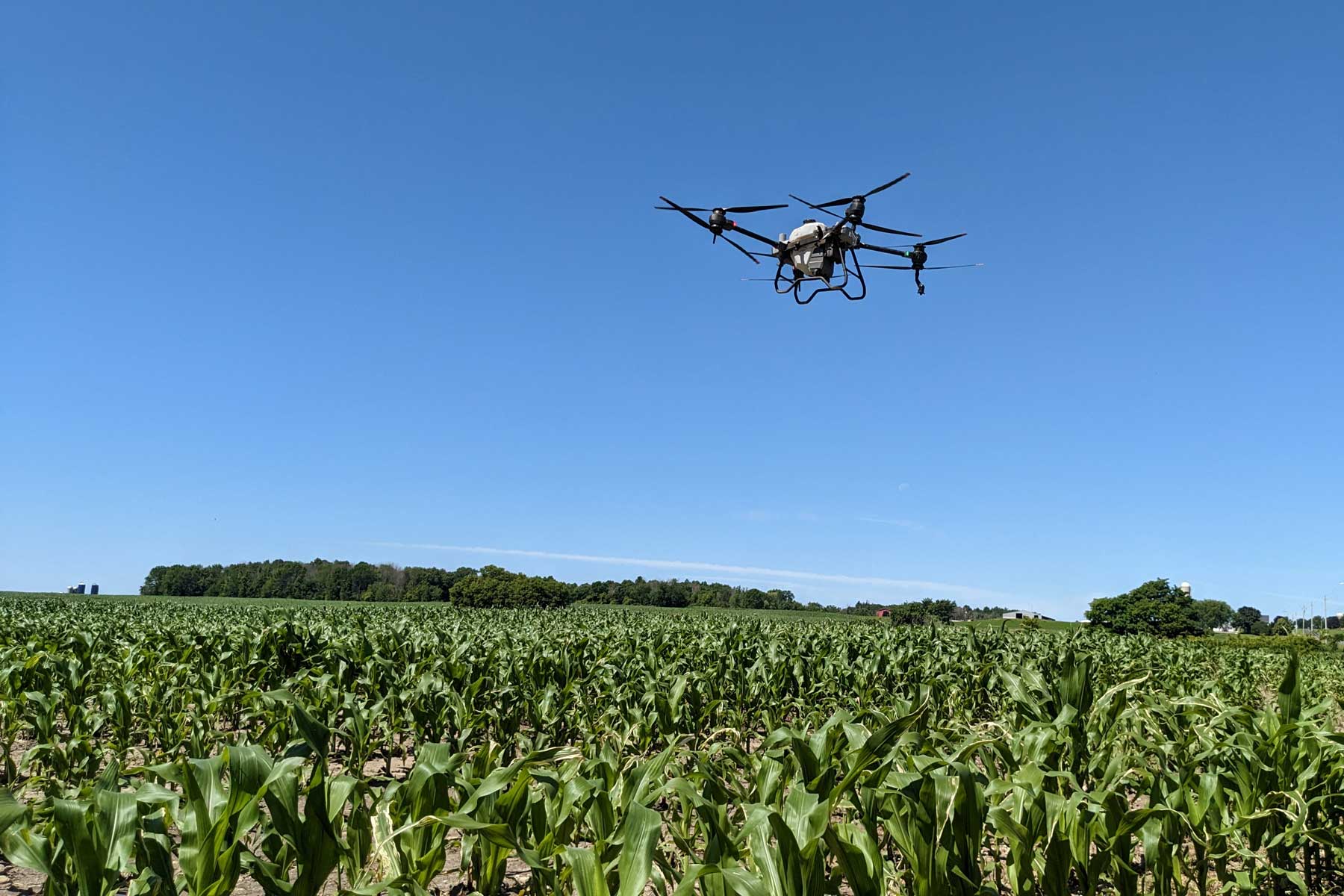
New technologies from the 2020s also bolster targeted land conversion. By the 2030s, most farmers use precision agriculture tools, drone imaging, and AI-powered calculations to much more accurately measure which portions of their fields turn a profit or loss. Calculation tools seamlessly incorporate government incentives and generate reliable recommendations of when marginal land conversion is most profitable.
The new tools are paired with smart technology that allows farm equipment to work around even very small patches of restored land. The software churns out statistical modeling that indicates where micro-restoration or conservation practice use should take place, and once the practices are implemented, scanning software generates a report to government regulators to initiate incentive payments.
Rural landscapes diversify
Over the course of the 2030s and 2040s, rural landscapes become an increasingly diverse patchwork of land uses. Corn ethanol production declines due to the growth of electric vehicles, though a portion of producers are able to pivot to supply airlines’ aviation fuel needs, taking advantage of state tax credits.[4↓]
Some growers lean on the expanded incentives to transition most of their lands to grazing, supplying urban consumers who are increasingly interested in local food and increasingly struggle to afford imported food products due to global trade barriers.[5↓] Others draw on a combination of nutrient loss reduction incentives, plus new public-private “payment for ecosystem service” partnership programs, and restore portions of their field to natural forest or wetland.[6↓]
Because of the focus on hotspots, these changes proceed unevenly across the landscape, and converted lands are concentrated in the areas that received the most external support. Proponents herald the efficiency of this approach, with government dollars going to areas where bang for buck is the greatest. The generosity of these incentives leads to debate over where the boundaries of priority areas should be drawn, and some farmers joke that they’d better increase their nutrient runoff so they can become eligible for federal incentives.
Nonetheless, by 2050, cover crops and edge-of-field treatments are more widespread, and producers have converted around 15% of cropland to perennial agriculture or restored ecosystems.
Outcomes for Food, Biofuel, Water, and Ecosystems in Hotspots for Transformation
Explore the model results for Hotspots for Transformation to see the projected outcomes of the changes that occur for food and biofuel production, water quality and quantity, and ecosystem health.
Footnotes: Real Ideas from Today
[1↑] For more details on how these transitions could happen, see the other three scenarios of this project.
[2↑] Houser, Matthew, and Diana Stuart. (2020.) “An Accelerating Treadmill and an Overlooked Contradiction in Industrial Agriculture: Climate Change and Nitrogen Fertilizer.” Journal of Agrarian Change 20 (2): 215–37. https://doi.org/10.1111/joac.12341.
[3↑] Jacobo, Julia. (June 16, 2025.) First-ever ban on watering lawns in central Iowa due to nitrate levels in rivers. ABC News.
[4↑] See “Cropland Conservation” for more details on how this change could occur.
[5↑] See “America’s Pasture” for more details on how this change could occur.
[6↑] See “Restoration Agriculture” for more details on how this change could occur.