
Scenario Narrative
America’s Pasture
In 2050, more than half of all farmland is grazing land.
Scenario Synopsis
In 2050, the Upper Mississippi River Basin is beginning to once again bear some resemblance to the prairie landscapes that existed before the arrival of European colonists.
Corn ethanol production has declined sharply due to the wide adoption of electric vehicles. In its place, producers graze cattle on perennial grassland and weave their livestock around a variety of other land uses—row crops, fruit and nut agroforestry, agrivoltaics, and more.
Key Landscape-Related Changes by 2050
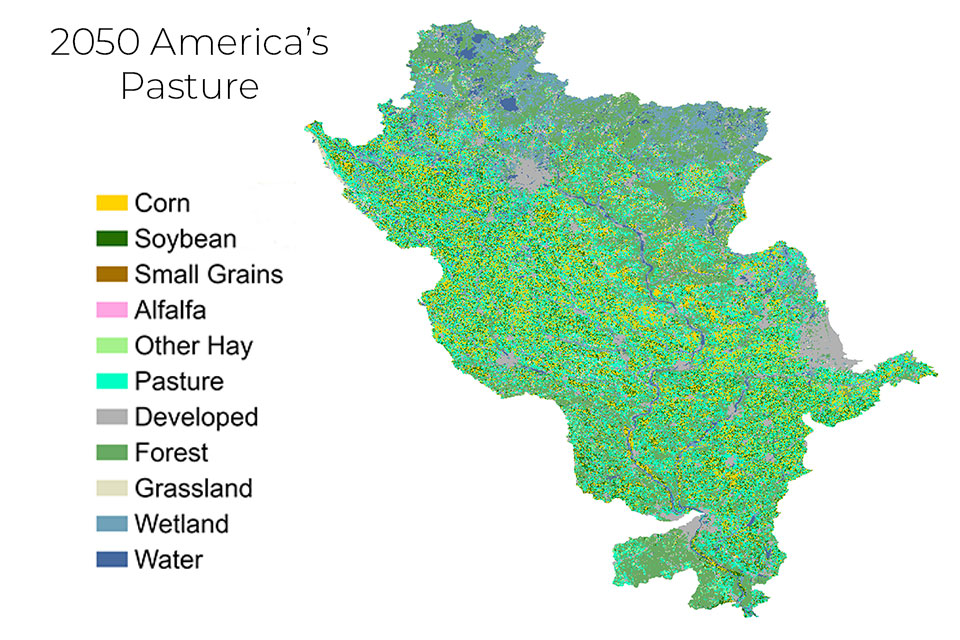
- Half of all cropland has been converted to perennial agroecosystems, including managed grazing and agroforestry.
- 50% of remaining annual croplands incorporate cover crops.
- Corn ethanol production has been virtually eliminated, due to the transition to electric vehicles.
- Americans consume slightly less total meat and dairy, but significantly more grass-fed animal products.
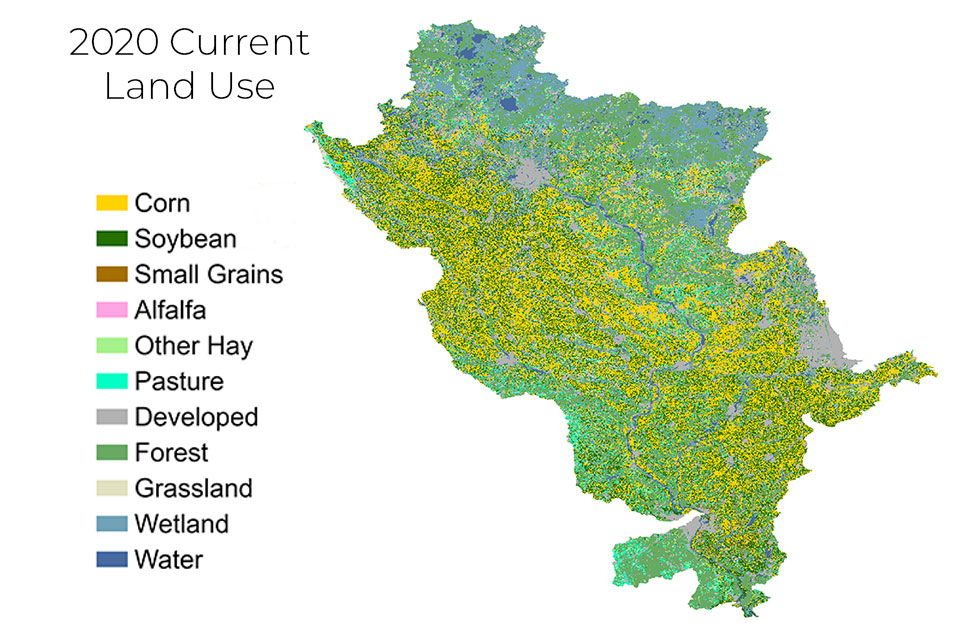
This land-use/land-cover map (left) depicts the Upper Mississippi River Basin in 2050 under the America’s Pasture scenario. Hover over the button above it to compare it with current land use/land cover (as of 2020).
The Full Story
In the late 2020s and early 2030s, row crop farmers become fed up with perpetual debt and worried about the health of the landscapes they love. So they trade in the corn rows for cattle herds and sow perennial grasses in their fields. They rotationally graze the animals on their new pastures and sell milk and meat to eager local customers. It’s a handsomely growing market, arising out of a set of intersecting economic and social trends that began in the decade prior.
Americans turn towards local landscapes—and local food
In the 2020s, a new strain of American politics focuses on making gains in Americans’ health and fighting chronic illness. It combines wariness of modern medicine, disdain for large food and drug corporations, and an affinity for regenerative agriculture. More Americans avoid processed food. Messaging about regenerating soils and improving health outcomes resonates with some farmers.[1↓]
In 2018, the market share held by large food companies begins to edge downward. It dwindles through the 2020s as inflation hits food prices and Americans grow more wary of processed food.[2↓] It’s also driven in part by rising use of weight-loss drugs, which cut Americans’ appetites for junk food.
By the late 2020s, backlash grows to the wave of new technologies defining American life, including social media, smartphones, and artificial intelligence. Some states ban devices in schools.[3↓] Smartphone break-up handbooks become bestsellers, and many of them advocate that Americans replace the connectivity of apps and screens with connection to the ecoregions they call home[4↓]: a burgeoning sense of belonging to the Great Plains, the Driftless, the Northwoods, or the Mississippi River basin.
As a result of all these trends, Midwesterners are increasingly willing to pay a premium for food that sustains the landscapes around them. Farmers’ markets, farm-to-table restaurants, and community-supported agriculture programs become more common over the late 2020s and early 2030s. Intentional communities focused on healthy eating and small-scale farming pop up in American suburbs.[5↓] Due to growing customer demand, schools, hospitals, and other institutional buyers also ramp up their local food sourcing.
At the same time, electric vehicle adoption grows and biofuel feedstock prices falter. The growing demand for local beef and dairy drives some early adopters in the Corn Belt to transition from row crops to grazing, underpinned by the growing popularity of regenerative agriculture and new U.S. Department of Agriculture insurance schemes for perennial production.
Global economic convulsions reshape Midwest agriculture
Amid these trends, the “free trade” era of global commerce unravels. In the United States, Democratic administrations aim to boost domestic green industry with “Buy American” provisions, and Republicans raise tariffs with the goal of re-shoring lost manufacturing jobs. Headlines augur “the end of globalization” and a “new era of US protectionism.” Other nations strike back with tariffs of their own. And following a pattern that first emerged during the COVID-19 pandemic,[6↓] countries periodically restrict food exports, especially in the wake of new climate-change-driven shocks. Cycles of retaliatory trade restrictions spiral across the decades that follow.
In the United States, imported fruits, vegetables, and meat rise in price.[7↓] By 2035, imports like bananas and avocados are premium goods that many shoppers forego. Other products formerly shipped in from abroad stop being available at all. Tariffs drive up the costs of imported fertilizer, and hurt American sellers, too. China, the largest purchaser of American soybeans, begins sourcing from Brazil and other major global producers instead.[8↓]
In speeches full of barbed rhetoric, politicians blame international rivals for the shortages. Invoking 20th-century “victory gardens,” they say that America now needs a wartime food system. Only, this time, the war will be fought through trade rather than on the battlefield. They exhort American farmers to serve their country by filling the gaps in food imports.
Many Midwestern growers respond to the call. Conversion to pasture offers them the chance to undercut the high prices of imported grass-fed beef. They also take advantage of a set of recent policy nudges that aim to support domestic markets. For instance, all beef products on shelves are now emblazoned with prominent labels indicating US or foreign country of origin.
Some producers dot their new pastures with intercropped trees and gain a handsome profit selling fruit and nuts to customers priced out of imported alternatives. These new “silvopasture” systems also have the added benefit of reducing livestock stress from more frequent extreme heat. More traditionally minded growers plant apples and pears. Others, inspired by Native chefs working to revitalize Indigenous foodways[9↓], supply locavore customers eager to try aronia, chokecherries, serviceberries, and other fruits endemic to the region.
Meanwhile, some growers graze cows or sheep around fields of solar panels, especially in the northern fringe of the basin, where the new agrivoltaics replace tariffed Canadian electricity imports.
Statehouses support the grazing transition
As this transition gains momentum, environmental nonprofits and dairy business interests strike a grand bargain in Wisconsin.[10↓] Together, the groups persuade the state legislature to invest substantial funding in transitions to grazing. The state establishes a program providing technical support for transitions to grazing and structured buyouts of farmer debt as they shift to operations that are profitable, but don’t generate enough revenue to keep up with existing debt service.
For farms that remain in row crops, the Wisconsin bill provides some incentives for cover crops and regenerative practices like no-till. Some climate groups balk at this compromise, as even grazed beef comes with substantial carbon emissions. But the incentives prove popular among growers, and the success of the bill inspires copycat efforts in other Mississippi River Basin states, where grazing incentive programs are folded into state nutrient loss reduction strategies.
Over time, pastureland acquires new meaning in farmers’ collective imagination. Once seen as appropriate only on land too poor for row crops, perennial agriculture becomes a symbol of American strength. Grazing and agroforestry come to represent supremacy over international rivals—almost a matter of national security. “America’s farms, America’s food” bumper stickers become ubiquitous on roads across the Midwest, and many growers take pride in supplying customers in their own region.
In the 2040s, legislators in Washington, DC aim to entrench these changes to protect against future dependence on imported food. Congress passes a farm bill with a 10-year plan to phase out row crop subsidies and overhaul the Environmental Quality Incentives Program to better serve graziers.[11↓] These changes spur grazing transitions among another wave of growers, and by the close of the decade, around half of former corn and soy land is in pasture.
Not everyone has bought into the new locally oriented mindset, though. Some longtime dairy farmers frown upon the lower per-acre beef and milk output of pastureland and continue to concentrate production in grain-fed operations. And some Americans also complain that the lower supply of grazed beef has led them to cut back on the cheeseburgers and barbecue they grew up eating. But by 2050, food markets have found a new, domestically oriented equilibrium, and memories of shortages fade.
Outcomes for Food, Biofuel, Water, and Ecosystems in America’s Pasture
Explore the model results for America’s Pasture to see the projected outcomes of the changes that occur for food and biofuel production, water quality and quantity, and ecosystem health.
Footnotes: Real Ideas from Today
[1↑] Held, Lisa. (August 19, 2025.) Should Regenerative Farmers Pin Hopes on RFK Jr.’s MAHA? Civil Eats.
[2↑] Kraft Heinz is not the only food giant in trouble. The Economist. July 17, 2025.
[3↑] Demillo, Andrew. (January 16, 2025.) “Banning Cellphones in Schools Gains Popularity in Red and Blue States.” AP News.
[4↑] The 2019 bestselling book How to Do Nothing: Resisting the Attention Economy by Jenny Odell advocates for cultivating bioregional identity as a way of breaking free from the technological “attention economy.”
[5↑] This Ohio Farm Community is a Mecca for the ‘MAHA Mom.’ The New York Times. August 8, 2025.
[6↑] Falkendal, Theresa, Christian Otto, Jacob Schewe, Jonas Jägermeyr, Megan Konar, Matti Kummu, Ben Watkins, and Michael J. Puma. (2021.) “Grain Export Restrictions during COVID-19 Risk Food Insecurity in Many Low- and Middle-Income Countries.” Nature Food 2 (1): 11–14. https://doi.org/10.1038/s43016-020-00211-7.
[7↑] For most major food groups, the United States produces enough to theoretically feed the entire country’s population, but not fruits and vegetables, according to Stehl, Jonas, Alexander Vonderschmidt, Sebastian Vollmer, Peter Alexander, and Lindsay M. Jaacks. (2025.) “Gap between National Food Production and Food-Based Dietary Guidance Highlights Lack of National Self-Sufficiency.” Nature Food 6 (6): 571–76. https://doi.org/10.1038/s43016-025-01173-4.
[8↑] Schulz, Bailey. (15 September, 2025.) “American farmers warn this year feels especially dire. What happens next?” USA Today.
[9↑] Nelson, Kate. (May 20, 2025.) Sean Sherman Expands His Vision for Decolonizing the US Food System. Civil Eats.
[10↑] This deal builds on advocacy that began in the 2020s. It’s also modeled after a similar “Green Tripartite Agreement” from Denmark in 2024. See Kaeding, Danielle. (April 14, 2025.) “Bipartisan Bill Backs Grazing Practices That Benefit Wisconsin Water Quality and Livestock.” Wisconsin State Farmer.
[11↑] Lowe, Erin & Ana Fochesatto. (January 2023). Just Transitions to Managed Livestock Grazing: Needs and Opportunities for Change in Midwestern United States. Grassland 2.0.