
Scenario Narrative
Cropland Conservation
In 2050, almost all agriculture is conservation agriculture.
Scenario Synopsis
In 2050, a bird’s-eye view of the Upper Mississippi River Basin’s rural landscape would suggest it hasn’t changed much: Corn and soybeans are still the dominant crops, and they still supply the fuel, meat, dairy, and export sectors. But look closer at a typical row crop farm, and differences start to become clear.
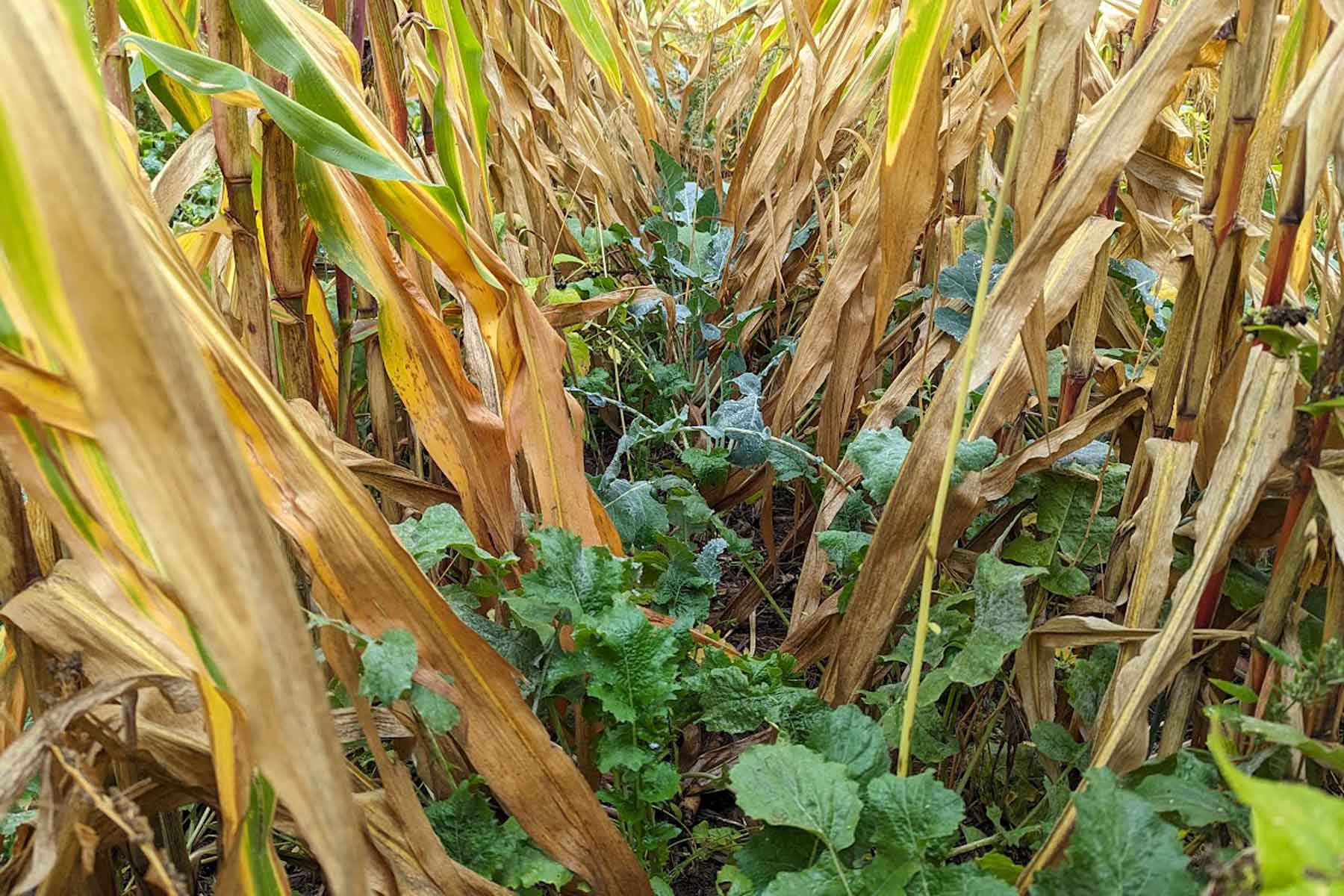
Cover crops are widespread. Zero and reduced tillage dominate. Saturated buffers and other edge-of-field practices filter a large portion of farm runoff before it reaches waterways. Corn ethanol production continues under these new systems, though it now primarily supplies fuel for aviation.
Key Landscape-Related Changes by 2050
- Cover crops, no-till, and other conservation practices are each used on 75% of cropland. Edge-of-field treatments are used on 75% of suitable tile-drained cropland.
- Corn and soy have a land footprint nearly identical to 2025, and still supply meat, dairy, and crop exports.
- Fertilizer application rates have declined 25%.
- Due to the rise of electric cars, corn ethanol now primarily supplies aviation fuel.
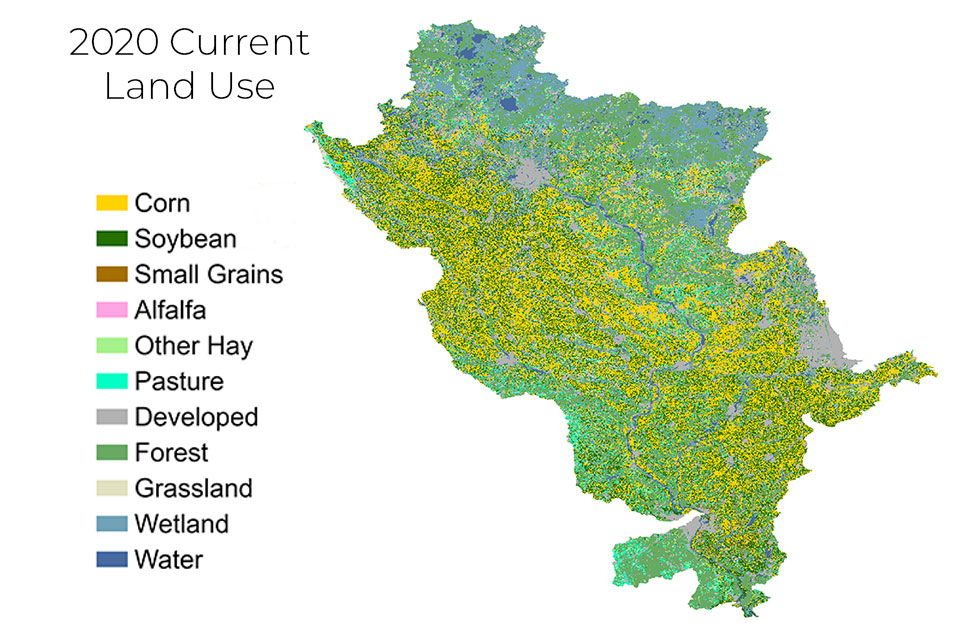
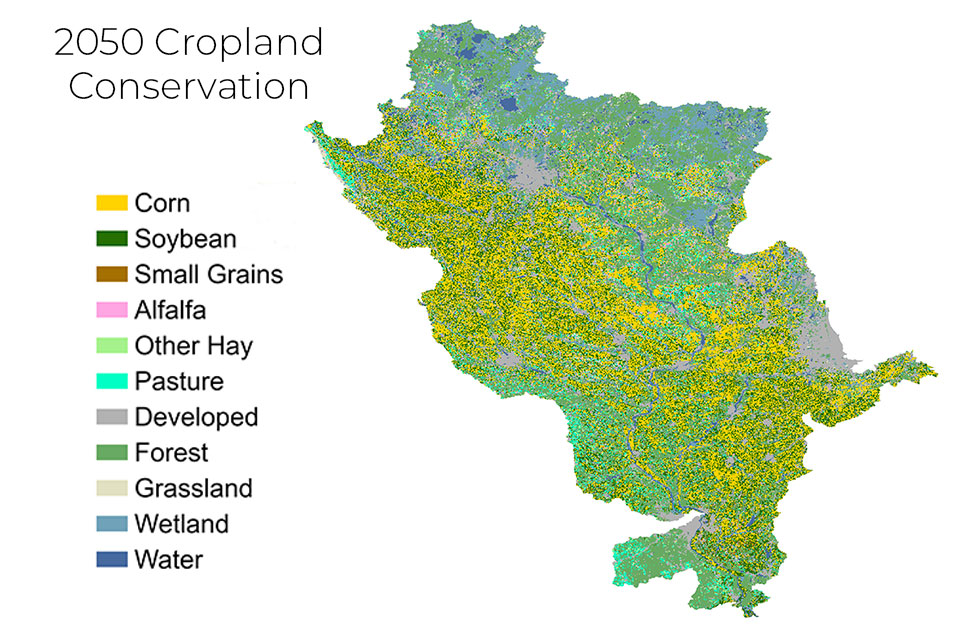
This land-use/land-cover map (left) depicts the Upper Mississippi River Basin in 2050 under the Cropland Conservation scenario. Hover over the button above it to compare it with current land use/land cover (as of 2020).
The Full Story
By 2050, many observers of American agriculture describe the 21st Century as “the age of the conservation farmer.” Intensive row crop production continues in a manner similar to preceding decades.
Now, though, the typical American field is host to a portfolio of practices designed to buffer its impacts on the surrounding landscape. Rye, vetch, clover, and other cover crops are ubiquitous. Nutrient runoff passes through saturated buffers before leaving most fields. Conventional tillage is rare.
The transformation began decades prior, emerging from a changing economic and political landscape.
Changes in global aviation drive a shift in biofuel production
In the late 2020s, nutrient management planning and cover crop use start to edge upward among Midwestern row crop farmers, spurred by dramatic changes in markets for biofuel feedstock. It begins in 2023, when the European Union (EU) establishes its Carbon Border Adjustment Mechanism, a tax for carbon-intensive goods imported into the territory, such as cement, steel, and fertilizer.[1↓]
The decade that follows is marked by a series of high-profile climate disasters: an unprecedented series of floods, heatwaves, and hurricanes that make climate change unmistakable to a growing number of people. Climate alarm ratchets up to new heights around the world.[2↓]
In response, the EU expands its tax policy on carbon-intensive imports, inspired by an international agreement that established a carbon fee for global shipping in 2025.[3↓] Under the new rules, European airports charge incoming international flights a substantial fee based on the carbon intensity of their fuels. Jet fuel derived from corn ethanol is exempt from these taxes, as long as EU standards are met. The rules dictate that farms producing crops for biofuels must use no till and cover cropping. Soon after, dozens of countries outside the EU respond with reciprocal fees.
These changes result in significant costs for American airline companies that fly internationally. They rush to scale up their “sustainable aviation fuel” (SAF) programs, many of which began at the beginning of the 2020s. The airlines lean most heavily on suppliers who source from biofuel producers in Minnesota and Illinois, where state tax credits became available for SAF in the early 2020s. Airlines and their suppliers offer purchase price bumps for growers in these states in exchange for the implementation of required tillage, cover crop, and nutrient management practices.
By the late 2020s, farm landscapes in the two states are smattered with rye, clover, and hairy vetch cover crops in late fall and winter. Waning demand for automobile biofuels, as electric cars make inroads in market share, makes these extra requirements a worthwhile trade for growers.
Midwestern states, and then Congress, expand support for sustainable aviation fuel
Sustainable aviation fuel becomes a boom industry for Minnesota and Illinois, and other Midwestern states quickly adopt similar incentives. Airlines offer generous advanced purchasing commitments for biofuel that meets sourcing requirements. Blending facilities that market to nearby airports pop up across the region, creating new manufacturing jobs in places like Moorhead[4↓], Sauget[5↓], Janesville, and Cedar Rapids.
By the mid-2030s, travelers departing from locations like Chicago, the Twin Cities, and Milwaukee are among few Americans not subject to “international carbon surcharges” that show up on booking websites when they purchase flights. Elected officials in the region regularly boast about their state’s role as a “global leader in sustainable aviation.”
Nonetheless, airlines are unable to source enough biofuel to avoid growing international carbon taxes. A coalition of large airlines, oil companies, and agribusiness interests lobby Congress to pass the “SAF Act,” providing an expansion of the Clean Fuel Production Tax Credit established in the 2020s, innovation grants, and public research and development funding.[6↓] A growing environmentalist faction in Congress[7↓] reacts warily, concerned that the biofuels’ climate benefits are based on faulty accounting.[8↓] But they ultimately decide that industry lobbying is insurmountable, and strike a deal.
Federal SAF incentives become law, though the skeptics in Congress manage to add a set of riders designed to help the incentives improve water quality. For producers and buyers to be eligible for SAF tax credits, biofuel must be grown with a set of mandated best management practices: year-round cover, nutrient planning, reduced fertilizer application, and edge of field treatments become effectively mandatory. For other growers, most states offer strong incentives through their nutrient loss reduction strategies for voluntary adoption of the same practices.
The deal also has spillover benefits for state nutrient loss reduction efforts: Because the SAF Act is expected to bolster large-scale corn and soy agriculture, political pressure to meet goals to reduce the Gulf of America hypoxic zone grows. Substantial new funding also flows to Mississippi River Basin states and Tribal nations for technical assistance and communications to help producers adopt promoted practices.
Conservation agriculture, fueled by aviation
In the late 2030s and early 2040s, new federal dollars fan out across the landscape. The proportion of SAF growers expands rapidly. By this point, automobile fuels use little corn ethanol, as cheaper electric cars have taken over the market.[9↓] So, SAF production provides a timely pivot for row crop farmers.
Installers of saturated buffers and bioreactors face frequent backlogs of work orders. Expanded cover cropping, the introduction of newly bred crop varieties[10↓], and the milder winters of a warming climate mean much of the Midwest is green almost year-round. Winter drivers on regional highways, especially at lower latitudes, often remark on the stark visual change in the rural landscapes they drive past.
By the middle of the decade, around three-quarters of growers use some combination of cover crops, conservation tillage, nutrient management planning, and edge-of-field practices. And due to the combination of federal incentives, state incentives, and SAF price premiums, profits are up for many farmers compared to prior decades.
Advances in farm technology also provide a boost to SAF and conservation goals. Precision irrigation expands, especially in the western part of the Mississippi River Basin. New tools for precision nutrient application allow farmers to increase their return on investment in fertilizer and their fields’ nutrient use efficiency. More producers use controlled drainage and flood retention infrastructure to recycle water and capture more of the nutrients it contains.
The U.S. Department of Agriculture and its Natural Resources Conservation Service hire a wave of new staff to track compliance with all the new requirements. There’s a downside, though. Compliance is sometimes burdensome for farmers, especially those who are most protective of their privacy. They have to accommodate visits from inspectors, plus consent to having their land photographed via high-resolution satellite image to verify use of required practices. Regulators succeed in softening the burden somewhat by placing a renewed emphasis on efficiency and streamlined user experience.
Some critics also lament what they view as the narrowness of reformers’ vision. Yield remains the overriding goal of American agriculture, with the bulk of each year’s harvest not intended for human consumption. But on the other hand, as environmentally oriented management expands, “conservation agriculture” becomes almost an oxymoron; nearly all agriculture is conservation agriculture. For many, it becomes hard to imagine anything else, and earlier forms of production become relics of what seems like a distant past.
Outcomes for Food, Biofuel, Water, and Ecosystems in Cropland Conservation
Explore the model results for Cropland Conservation to see the projected outcomes of the changes that occur for food and biofuel production, water quality and quantity, and ecosystem health.
Footnotes: Real Ideas from Today
[1↑] Carbon Border Adjustment Mechanism. European Commission. March 28, 2025.
[2↑] Research indicates that whether or not people attribute extreme events to climate change has an important connection to what climate policies they support. See, for instance, Cologna, Viktoria, Simona Meiler, Chahan M. Kropf, et al. (2025.) “Extreme Weather Event Attribution Predicts Climate Policy Support across the World.” Nature Climate Change 15 (7): 725–35.
[3↑] McDermott, J. & S. Arasu. (April 11, 2025). Major nations agree on first-ever global fee on greenhouse gases with plan that targets shipping. AP News.
[4↑] Minnesota Sustainable Aviation Fuel Hub Overview. February 2025.
[5↑] The Future of Fuel: How Illinois is Championing Sustainability in Aviation. Illinois Economic Development Corporation. January 6, 2025.
[6↑] “Americans for Clean Aviation Fuels” is a coalition advocating for these policies. It includes Delta Airlines, ExxonMobil, the Iowa Soybean Association, and others.
[7↑] See “Restoration Agriculture” for details on how this faction might grow.
[8↑] For a present-day example of this concern, see Grunwald, Michael. (May 27, 2025.) “The ‘Green’ Aviation Fuel That Would Increase Carbon Emissions.” Yale E360.
[9↑] See “Restoration Agriculture” for details on how corn ethanol use could decline.
[10↑] Such breeding is underway at programs like the University of Minnesota’s “Forever Green Initiative.”