

Scenario Narrative
Restoration Agriculture
In 2050, farmers tend not just crops, but also restored forests, wetlands, and prairies.
Scenario Synopsis
In 2050, the Upper Mississippi River Basin is an increasingly multifunctional mosaic, one with less farming and more forests, prairies, and wetlands.
Corn ethanol production has declined sharply, due to the widespread adoption of electric vehicles. Farmers maintain traditional crops, but also steward a swath of young woodlands, prairies, marshes, and peatlands, all growing out of former corn and soybean fields.
Key Landscape-Related Changes by 2050
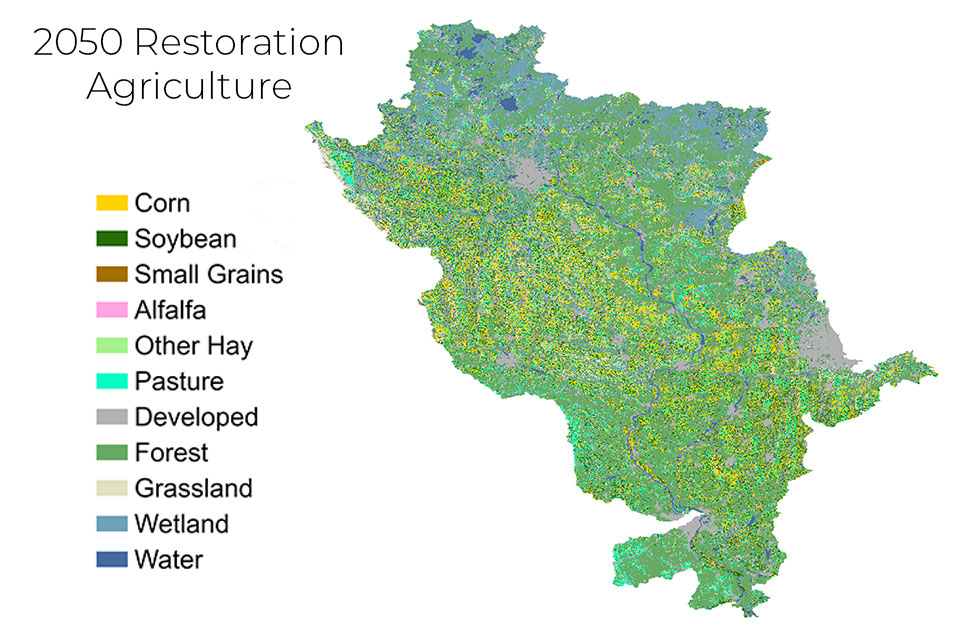
- Half of all cropland has been converted to restored ecosystems, including wetlands, forests, and grasslands.
- “Payment for ecosystem services” programs allow farmers to make a living through a combination of crop production and ecosystem stewardship.
- Corn ethanol production has been virtually eliminated, due to the transition to electric vehicles.
- Plant-based diets boom; meat and dairy consumption declines significantly.
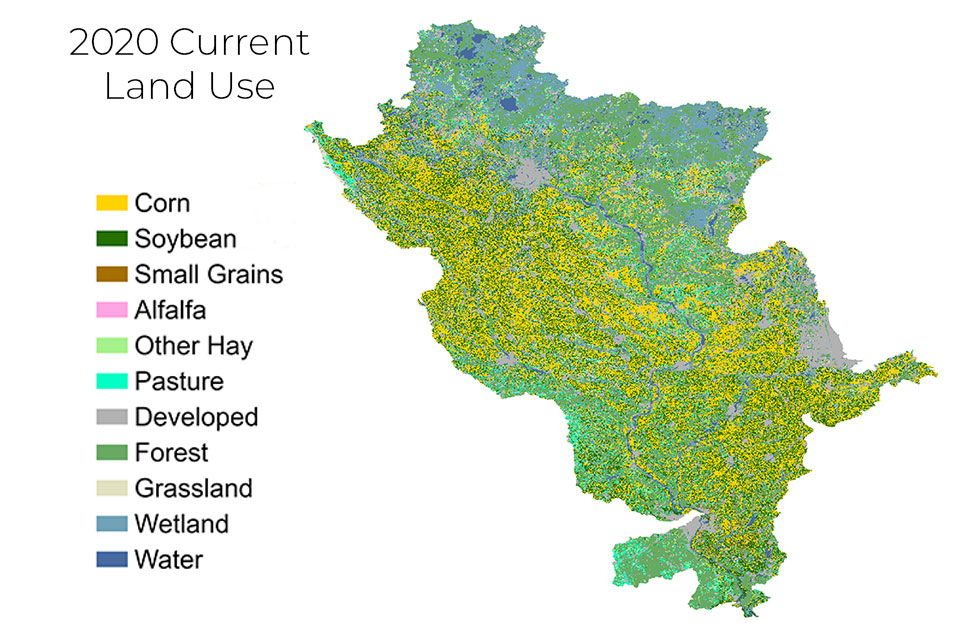
This land-use/land-cover map (left) depicts the Upper Mississippi River Basin in 2050 under the Restoration Agriculture scenario. Hover over the button above it to compare it with current land use/land cover (as of 2020).
The Full Story
In the 2030s, as increasingly frequent droughts and heat waves ravage fields, some producers begin rethinking what it means to be a farmer. They conclude that they must focus not just on feeding the world, but also on caring for the ecosystems on which the health of their land depends. On their least productive lands, they begin planting local tree species, constructing wetlands, and restoring prairies. Because of market shifts that began decades prior, they’re able to do so at little net cost to their bottom line.
An electric vehicle boom cuts into biofuel demand
The growth in biofuel production in the Midwest over the 2000s and 2010s turns into an economic liability for farmers. Through the 2020s, electric vehicle adoption continues along the exponential “S curve”[1↓] of growth that began at the beginning of the decade. Around 2030, EVs establish a decisive economic advantage over their internal-combustion counterparts, fueled by high-efficiency silicon anode batteries and increasingly cheap daytime solar and wind power. Americans buying new cars can save thousands of dollars by going electric, and automakers begin to phase out gas-powered vehicles.
These changes leave producers of corn ethanol in the lurch. Purchasers cut back on orders, and growers scramble to plant alternative crops or find new markets for corn. Exports increase, as countries where climate change has harmed corn production look for alternate food sources. Because of these nations’ lower purchasing power, revenues decline for growers. A small portion of producers take corn fields out of production entirely.
Extreme weather alarms consumers and forces more producers to pivot
The 2012 drought, 2020 West Coast wildfires, and 2024 Midwest heatwaves prove a harbinger of things to come. Climate change intensifies over the course of the 2020s and 2030s, making those extreme events feel as though they are near-annual occurrences. Shocked American eaters grow more carbon-conscious, especially Millennials, Gen Z, and younger generations born into the changing climate.
As extreme weather cuts into farm yields, food grows more expensive, and grain-fed animal products strain shoppers’ budgets. Clever vegetarian chefs become social media stars. Their social media recipe videos often include a grocery store budget estimate and rough carbon footprint calculation. Dairy and beef consumption decline and plant-based diets boom.
In the wake of these changes, markets for biofuels and silage corn suffer further. Some producers begin to take land out of row crops, especially in Iowa, Illinois, and southern Minnesota. Persistent hot and dry conditions parch farmland that remains in production, raising the specter of a climate-change-fueled “second Dust Bowl.”
In response, a “restoration agriculture” movement takes hold. It grows out of the push for regenerative agriculture in prior decades, led by multi-generational farmers worried about the fate of the landscapes for which their parents and grandparents had cared.
These producers discover that, due to the lower crop production from increasingly hostile weather, they are able to restore forests and wetlands in underperforming portions of their fields without sacrificing profits. Many manage to make restoration profitable by brokering deals with major corporations looking to purchase carbon credits to offset their emissions.[2↓]
Lawmakers overhaul the Farm Bill to fund ecosystem restoration
Together with voters alarmed by extreme weather, these farmers elect a wave of new Midwestern lawmakers with a mandate to protect rural lands. In the late 2030s, Senators from Iowa persuade Congress to revamp federal farm subsidies. They pass a reimagined “Farm, Forest, and Landscape Bill” focused on nature-based solutions for climate change. It overhauls the Conservation Stewardship Program and Environmental Quality Incentives Program, vastly expanding the funding available and practices that qualify.[3↓]
The bill also provides a set of incentives for green infrastructure in urban areas. Developers start to incorporate more native ecosystems into construction, minimize impervious surface, and carve out green corridors that run through cities.
In line with national priorities, Mississippi River Basin states prioritize ecosystem restoration projects in their state nutrient loss reduction strategies. The states focus their energies for reducing nutrient pollution on nature-based solutions—such as wetland and floodplain restorations in agricultural areas and green infrastructure in urban areas. They create incentive programs for farmers to convert marginal and flood-prone cropland into natural ecosystems and for urban communities to install large and small-scale green infrastructure projects.
For large corporations, pressure to reach net-zero carbon emissions grows. They layer private carbon markets onto the new public programs, creating extra incentives for restoration in high-impact zones. Under the new programs, producers are able to enter an ecosystem service market that provides profitable long-term contracts to restore natural ecosystems on former farmland.
By the 2040s, thousands of young U.S. Department of Agriculture “Climate and Conservation Corps” employees fan out across the region each growing season in pickup trucks. Equipped with cutting-edge digital tools, they move from farm to farm conducting rapid biodiversity and carbon stock assessments. At each stop, they calculate preliminary results on a handheld tablet, often while their truck is still parked at the edge of each field. They then start the paperwork for a payment reimbursing producers for restoration costs, plus a stipend for each ton of carbon stored.
Fueled by these payments, restoration accelerates, and by 2050 half of former farmland is in the process of reconversion to its pre-agricultural state.[4↓] Grasslands and wetlands cover double the land area they did a few decades ago, and forest cover has increased by about a quarter. The change is especially pronounced in Iowa, Illinois, and southern Minnesota.
As agriculture across the world comes under increasing climate stress, some observers argue that, by moving land out of production, the United States is shirking its responsibility to help feed the world. As a result, some growers continue to focus primarily on row crop production, with an increased emphasis on food for humans to feed the plant-based diet market.
But many others now manage farmland woven into a mosaic of young forests, grasslands, and wetlands. A handful even abandon annual crops entirely and become full-time “forest farmers.”
For most growers, federal incentives and payments from carbon markets become their cornerstone revenue streams. But they supplement them with a panoply of products sourced from the ecosystems they steward: sustainably harvested timber for green housing in growing cities; certified “restored prairie beef” that earns premiums in local markets; access permits for deer hunting in forests and sport fishing in streams; or foraged mushrooms sent off to cities like Minneapolis, Madison, and Des Moines, where chefs and customers are always on the hunt for the next trendy wild food.
Outcomes for Food, Biofuel, Water, and Ecosystems in Restoration Agriculture
Explore the model results for Restoration Agriculture to see the projected outcomes of the changes that occur for food and biofuel production, water quality and quantity, and ecosystem health.
Footnotes: Real Ideas from Today
[1↑] The World Resources Institute has found that once EV sales reach 1% of passenger vehicle purchases in any country, growth accelerates. In Norway, EV sales went from 1% of the market in 2010 to 80% in 2022. EV growth has started later in many other countries, but is following a similar trajectory. See Jaeger, Joel. (December 5, 2025.) “These Countries Are Adopting Electric Vehicles the Fastest.” World Resources Institute.
[2↑] One such deal was struck in 2025 between Netflix and the American Forest Foundation, aiming to transition underused fields to forests. See Segal, Mark. (September 4, 2025.) “Netflix Signs 15-Year Carbon Credit Deal to Help Landowners Transition Fields into Forests.” ESG Today.
[3↑] The revamped programs are modeled off of Costa Rica’s Payment for Environmental Services Program, which offered farmers five- or ten-year contracts in which they receive cash payments in exchange for ecosystem restoration. These payments increased forest cover from around 25% of the country in the 1990s to almost 60% in 2020. “Payments for Environmental Services Program | Costa Rica | UNFCCC.” See Lewis, Nell. (July 27, 2020.) “This Country Regrew Its Lost Forest. Can the World Learn from It?” CNN.
[4↑] These changes draw comparisons to New England, which was dominated by farms in the mid-1850s, but restored to more than 75% forest cover in many places by the early 21st century.